Diplodocus 3D skeleton
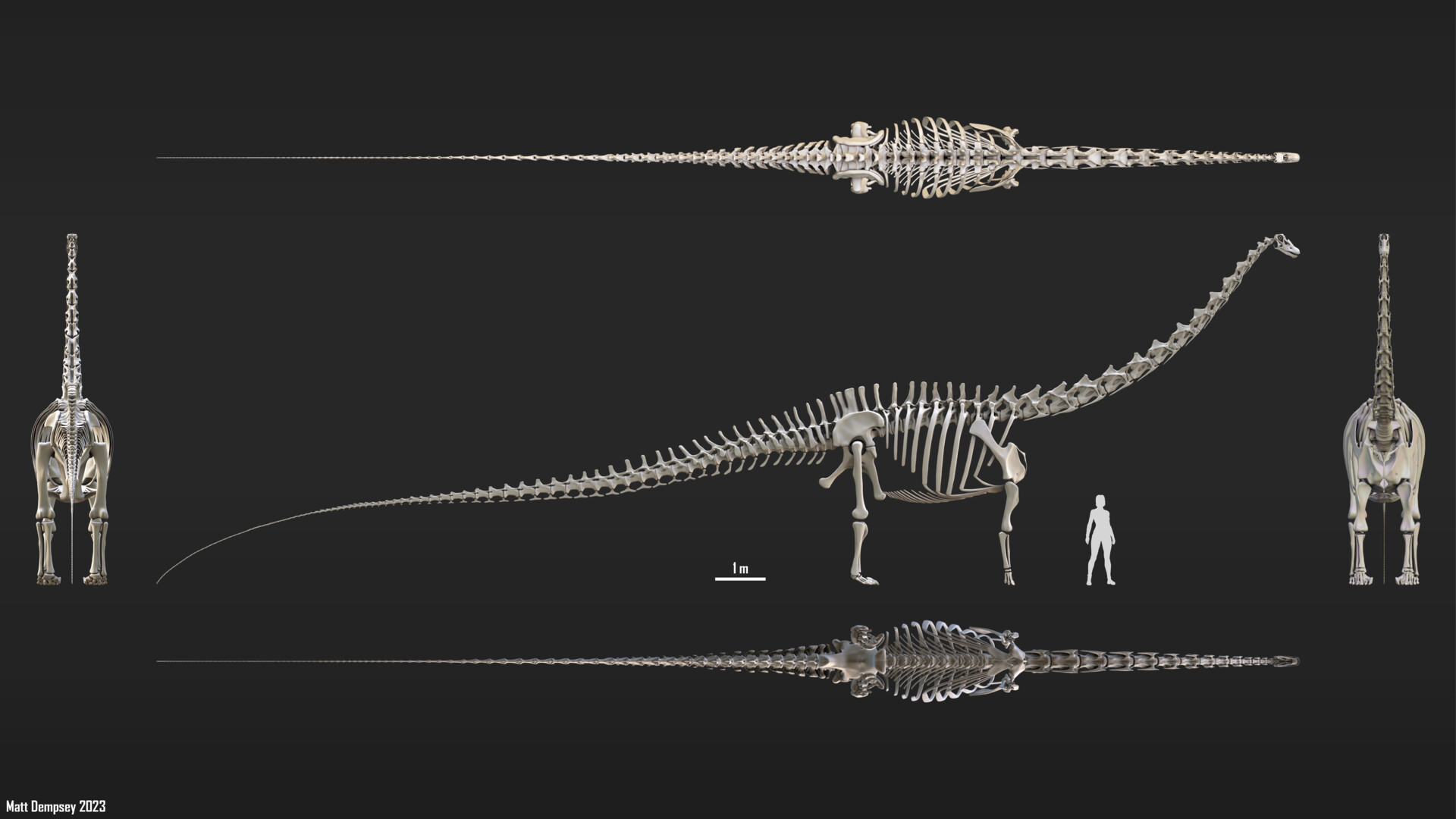
Modelling skeletal reconstructions in 3D is something I genuinely enjoy. It's a lot of work, but the end result looks nice, and can be a useful tool for reference. Anyway, here's my most recent endeavour - good old Diplodocus carnegii!
As with all of my 3D skeletons, there's a degree of shape generalisation here. It's mainly based on the classic "Dippy" (CM 84) specimen, which consists of more or less complete neck, torso, and hip segments, about half of the tail, the pectoral girdle, and a femur. The rest of the hindlimb and the midsection of the tail are mostly based on CM 94, the overlapping elements of which are very close in size to CM 84. Most of the rest of the tail can be inferred from CM 307. Combined, these three specimens make up the majority of most mounted Diplodocus displays (the classic Carnegie mount and its many, many historic casts).
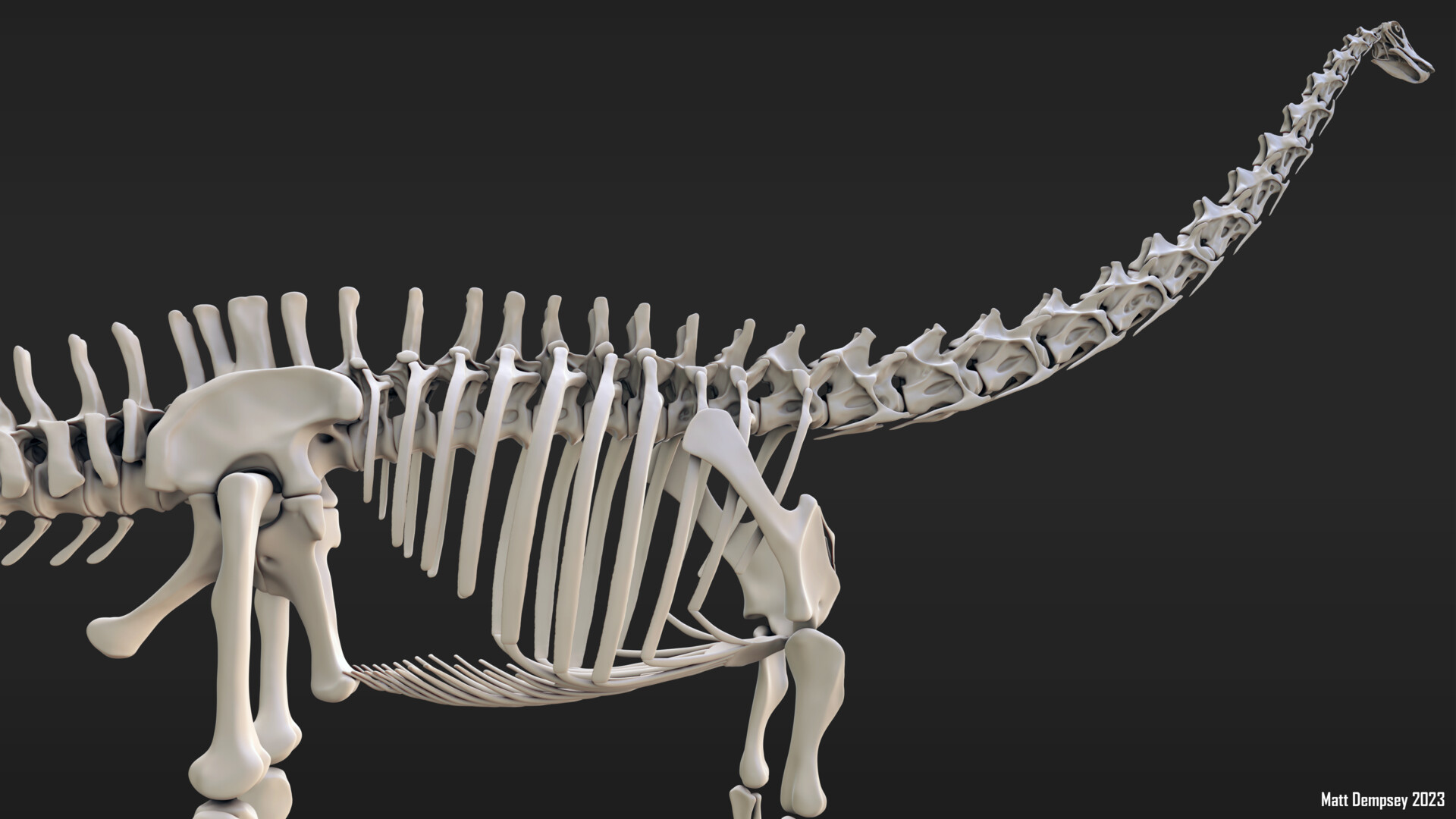
Most of the forelimb elements in my model are scaled according to USNM 10865, which is sometimes tentatively referred to Diplodocus longus. This skeleton is more or less equivalent in size to the classic Carnegie specimens. A handful (hahaha, pun) of specimens were the basis for the manus, including the Thermopolis FS quarry diplodocid (WDC-FS001A), a referred Diplodocus longus specimen (YPM 1906), as well as other diplodocids such as Galeamopus and Apatosaurus. For the form and orientation of the clavicular apparatus, sternal plates, sternal ribs, and gastralia, I followed Tschopp & Mateus 2012.
For such an iconic dinosaur, the skull of Diplodocus can be a bit of a headache (hahaha, another genius pun). From the broader diplodocine fossil record we know pretty much exactly what diplodocine skulls look like, but referral any of the abundance of the known skulls to Diplodocus specifically isn't something that we can do confidently. The skull in my model, as with many Diplodocus reconstructions, is something of a generalised amalgamation of the best-known diplodocine material, but draws quite heavily from the CM 11161 skull. The hyoid elements are based on "Max", which is the type specimen of Galeamopus pabsti (SMA 0011).
The orientation of the hips follows the principles of Vidal et al. 2020 (in which the posterior facet of the last sacral centra is alligned vertically), which is what results in the spine having a stronger slope overall. I prefer the principles of Vidal et al. for many reasons, including the way it results in the first section of the tail being alligned more horizontally or slightly sub-horizontally (as opposed to the strongly upwards-curving "ass in the air" orientation of reconstructions where the wedge of the hips is not accounted for). One of the key reasons I find this orientation preferable is mechanical. I would hypothesise that in the more conventional scenario in which the base of the tail was pointing upwards, the muscles involved in keeping the tail dorsoventrally stable (which is probably important for locomotion) would end up experiencing greater strain and/or having to do greater work than if the base of the tail was held horizontally. This isn't something that Vidal et al. discussed in their paper proposing sacral tilting in sauropods, but I think it's an intuitive next step of inference. Proper mechanical modelling would be required to validate this hypothesis, however.
The long debate on habitual neck posture in sauropods not something that I'm particularly interested in relitigating here, but one thing that I would quietly point out is that following the principles of Vidal et al. when orienting the hip means that only fairly subtle dorsiflexion of the neck is required to get the head into a very elevated position, without having to stack vertebrae all that steeply.
Anyway, I'm particularly happy with how this model turned out - I think it's some of my best technical work yet. Hopefully this provides folks with useful palaeoart reference!



One errant twitch...