Hatcher the Triceratops - 3D Muscle Dissection
Update: the model has received some subtle-ish tweaking to tidy up a few things that were bugging me. In hindsight, there were some relatively minor layeting details and gaps around the upper arm and triceps that didn't sit right with me. I've also rendered it out in a style equivalent to my recent skeletons. A labelled version, as well as updated close-ups and video footage will arrive eventually! Previous versions kept here for posterity - the square image with the dark grey background is the most recent version that I would recommend referencing! Uncompressed here: https://drive.google.com/file/d/1-gQ-G3Zn3cANpyRaspDAKBmZZ5Mq0z-Z/view
------------------------------------------------------------------------------------------------------------------------------
PREVIOUS DESCRTIPTION:
Here's a layer-by-layer look at the musculature of Hatcher the Triceratops, built atop reposed scans of the mounted skeleton made available by the Smithsonian DPO (https://3d.si.edu/object/3d/triceratops-horridus-marsh-1889%3Ad8c623be-4ebc-11ea-b77f-2e728ce88125).
The skeleton as mounted is currently being fed on by a Tyrannosaurus, so I spent a while splitting the model up and rearticulating it into a likely standing posture. A few extra bones not present in the 3D data (the sternal apparatus and a handful of hemal arches) were sculpted based on other ceratopsid specimens. Each muscle belly, visible tendon, cartilage cap, and other soft tissue features were sculpted one-by-one as independent meshes, interpreting their known attachments on the bones within the context of modern bird and reptile anatomy (the extant phylogenetic bracket), and scientific publications about ornithischian anatomy.
If you'd like to know more about what some of these muscles were doing, and how they might relate to load bearing action, posture and gait, then check out our new paper on the evolution of forelimb muscle leverages in ornithischian dinosaurs: https://royalsocietypublishing.org/doi/full/10.1098/rspb.2022.2435.
There are a few things I'm still tempted to tweak, but I'm pretty proud of how this one turned out, I think it's some of my best work. In the near future, I have plans to get an iteration of this 3D printed as a phyisical reference model.
A few points of potential interest that I'd like to highlight:
- The "Hatcher" Triceratops skeleton is a composite of multiple individuals, but the current mounted skeleton that this model is based on used digital rescaling and prototyping techniques to ensure that it had the correct proportions for Triceratops (compared to the historical mount, which notably had mismatched limbs and an overly large "humped" torso).
- Due to the skull used in the Hatcher composite, this model represents the species Triceratops horridus, which is characterised by a smaller nose horn and more recurved brow horns than the second younger species Triceratops prorsus.
- My reassembly of the ribcage is a little narrower than some mounted skeletons - this is mostly due to the combined effect of me articulating the ribs at a steeper angle, and in a slightly more swept back position. This isn't neccesarily more or less correct than the wider-torso mounts, as rib orientations are one of the most subjective parts of dinosaur skeletal reconstruction. Even in preserved articulated skeletons, taphonomic squashing can change the perceived orientation of the ribs, which can end up looking quite different between specimens. Ribs are also not static, as their orientation, and therefore the perceived volume of the torso, shifts during breathing.
- The bony "frill" of Triceratops is not an entirely free-hanging ornamental strucure. About half of it is backed by massive neck muscles, which we can infer from large depressions in the bone that correlate to muscle insertion. A lot of otherwise very good Triceratops art out there severely undermuscle the neck!
- Deep musculature connects the thighs to the hip bones across most of the depth of the body. These likely aid in the stabilisation of the limbs.
- The elbow morphology is quite extreme due to the large bony processes of the forearm (the olecranon). This increases the leverage of the triceps tendon, and appears to a convergent hallmark of heavy animals that bear great weights on their forelimbs. See our recent paper (linked above) for more discussion of the mechanics behind this!
- I avoided reconstructing a mammal-like cheek muscle (the "masseter"). Instead, the typical reptilian temporal jaw adductor muscles are extended across the length of the jaw, following a 2018 study by Ali Nabavizadeh. The lack of a novel cheek muscle does not however rule out the present of an elastic cheek-like skin structure in life - this is something that we see in multiple living bird and reptile species.
Anyway, I hope that this model provides a good reference material for anyone looking to make Triceratops art! As usual, I'd love to see what you made if you used this as a reference.

Updated version! (See description)
Uncompressed: https://drive.google.com/file/d/1-gQ-G3Zn3cANpyRaspDAKBmZZ5Mq0z-Z/view
Turntable video showing superficial musculature, deep musculature, and the underlying skeleton.

Superficial musculature, in addition to sinuses, horn sheaths, ugual (claw) sheaths, and fleshy pads lining the tendons of the toes and fingers.

Superficial musculature rendered in random colours - every muscle is its own mesh.

Note that much of the bony "frill" is backed by massive neck muscles - it's not just a free-hanging ornamental structure.
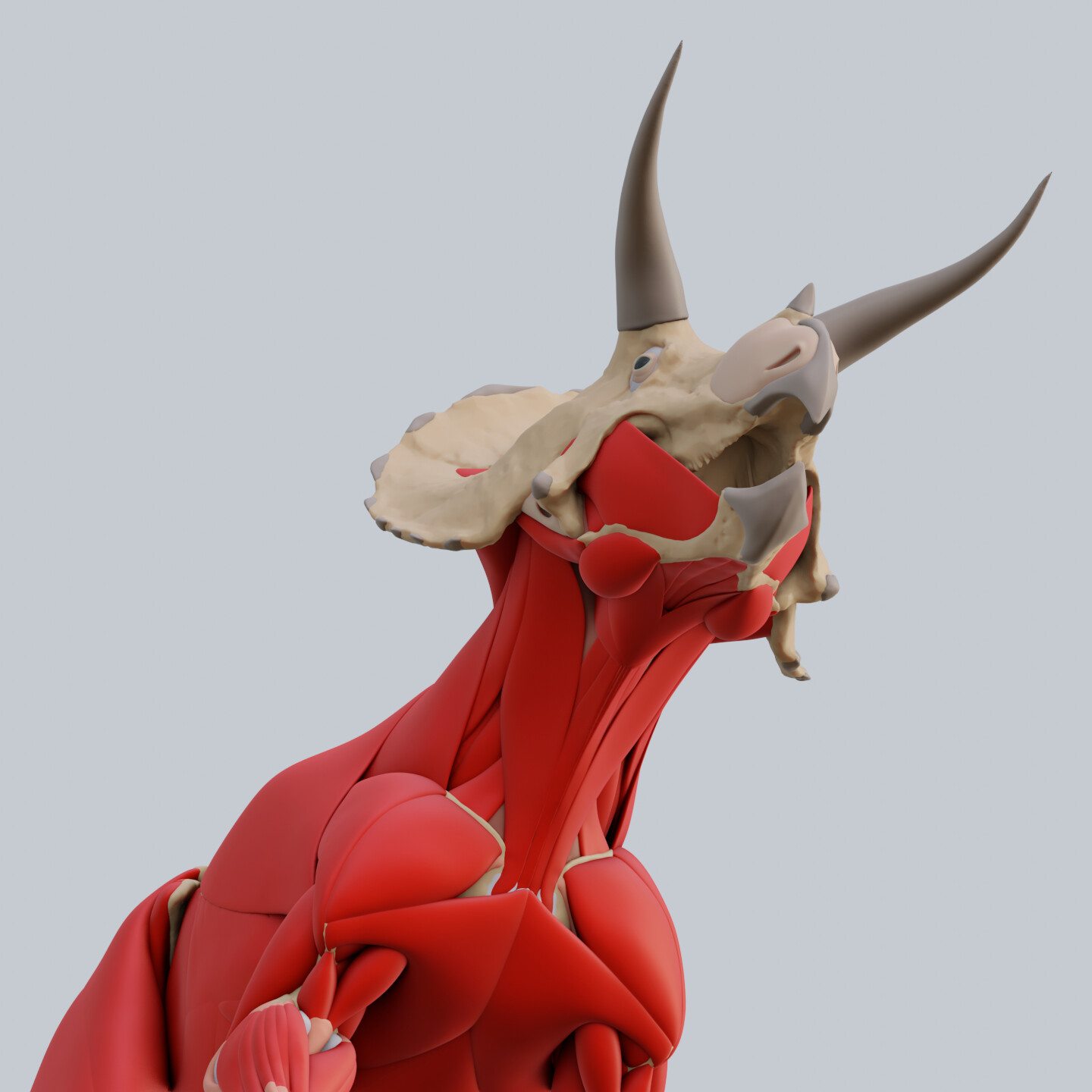
A complex overlapping system of muscle sheets connects the shoulder girdle to the neck and jaws. We humans have many of the same muscles, just a little less extreme.

Dorso-ventral views